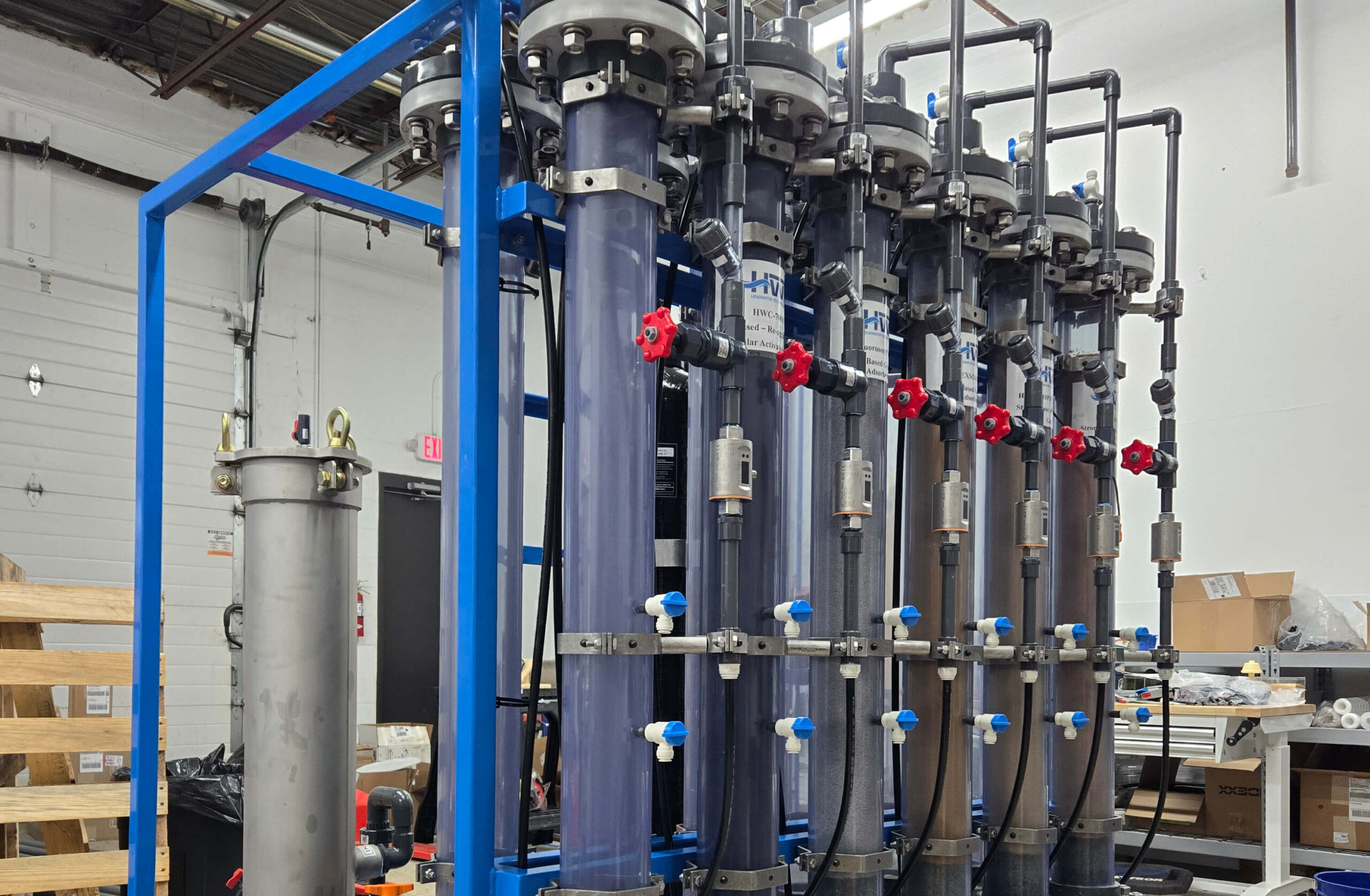
 Safe drinking water is fundamental to healthy communities, and the EPA’s responsibility under the Safe Drinking Water Act is to protect people’s drinking water from harmful chemicals. EPA is taking action to establish nationwide, legally enforceable drinking water limits for several well-researched PFAS chemicals and reduce PFAS exposure for Americans served by public drinking water systems (PDWS). To prepare for the established water limits, EPA selected EA to provide pilot systems for comparing a wide range of adsorption media (activated carbon, ion exchange media, and novel adsorbents).
EA designed and deployed six pilot systems in municipal drinking water treatment facilities selected by the EPA across four states. The pilot systems demonstrate PFAS removal in drinking water plants and provide valuable data for sizing adsorption columns and estimating operational costs. Data gathered from the pilot systems are used to refine EPA’s adsorption kinetics model across various media and PFAS species. The pilot system results will be used to compare the efficacy of adsorbent/exchange media and generate treatment performance data to design full-scale systems, project future operating costs, and assess regulatory implications.
Design Challenges
To address the challenges and constraints presented during the design process, the following design elements were implemented:
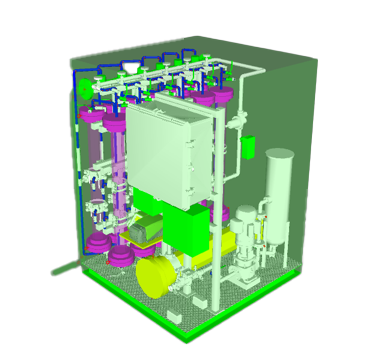
Compact Design – Installation inside multiple existing PDWSs required a small footprint so the skid systems could be installed in a variety of locations.
Arrangement – The small skids were fitted with a control panel, chemical pumps, chemical storage, cartridge filtration, a reaction vessel, twelve columns, pressure transducers, flow meters, and many valves in a small space. The system was arranged to provide access to all operating valves and equipment.
Commissioning and Startup – The skids were designed to allow access to each of the columns to allow for relatively easy loading of each media and adjustments to flow and pressure during operation. A split-column design was selected to accommodate standard ceiling heights and to allow personnel to reach the tops of the columns.
Multiple Column Design – To test and compare the efficacy of six different media per skid, the design incorporated independent column operation. The media type affects several system design parameters (pretreatment, hydraulic loading rates, empty bed contact times, and bed depths) for treating drinking water. Separate flow control for each column was critical to meet these system parameters.
Pretreatment Needs – Depending on the feed water quality from the facilities to the pilot system and which media are being tested, dechlorination may be required. Ion Exchange (IX) media does not tolerate chlorine and needs to be removed before exposure to the test columns. EA developed two designs, one with dechlorination and another without, to meet the pretreatment needs of a specific facility. The only design differences for dechlorination systems included a chemical metering pump, a reaction vessel, an oxidation-reduction potential meter, and a chlorine analyzer. Additionally, cartridge filtration was used to remove fine particulates from the source water that could cause media fouling.
Influent Feed – The skids were designed with booster pumps to assure adequate pressure for each of the six locations. The booster pump was included in the design, allowing it to be relocated to pull water from a distant source while still being controlled by the skid via power from the control panel, if needed. This proved to be a significant labor and cost savings in setting up the skids and meeting the needs of each site.
Sampling locations – Ports were strategically placed to collect samples at standardized depths of the media bed to assess PFAS breakthrough sooner and estimate media lifespan. Fine-gauge filtration ports were used to restrict media from flowing out of the sample ports during collection.
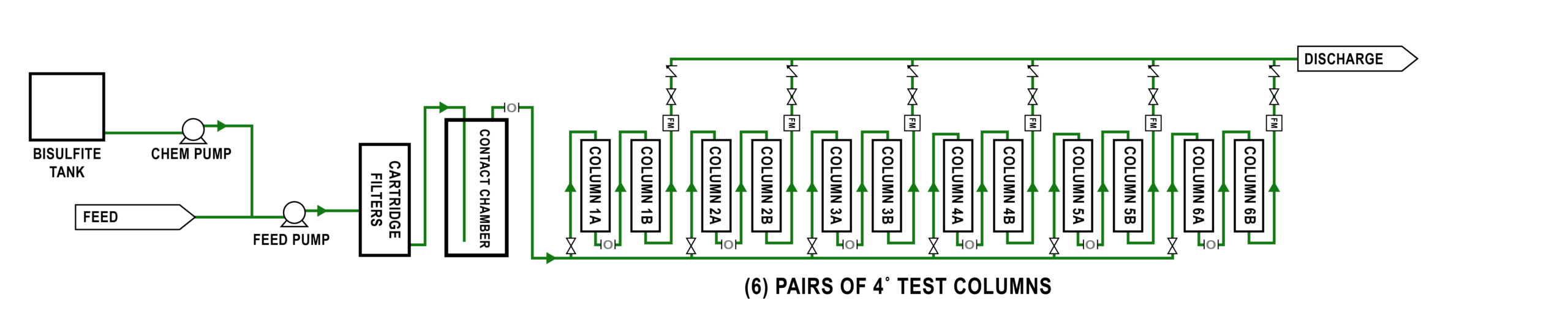
The influent water enters the pilot skid via a backflow preventer valve. For the dechlorination skids, sodium bisulfite is pumped from the chemical tank and is injected into the influent water stream. Then the skid booster pump feeds the water through the static mixer, cartridge filter, and bisulfite contact chamber before entering the six pairs of media columns. For non-dechlorination skids, the booster pump feeds the water through the cartridge filter before the six pairs of media columns. Each pair of columns acts as one column and contains a midpoint sample port.
PFAS Drinking Water Treatment Pilot Systems
Each pilot system can test 6 different adsorbent media simultaneously, using a split-column design and independent column controls to meet specific operational parameters for each media type. A sophisticated Human-Machine Interface (HMI) and an online dashboard enable EPA to monitor operational parameters and PFAS levels using Power BI. The operation of each pilot is governed by a programmable logic controller, which controls dechlorination, monitors for alarm conditions, records operational parameters (chlorine, flow, pressure, and alarms), and communicates with EA’s monitoring team. The pilot system control system was designed to make operations simple for the host water treatment plant operations team.
EA’s pilot system design factored in project goals, funding, the number of columns required to evaluate different media, flow, and pressure control for each column, source water for media selection, pretreatment requirements, and automation to ease facility operations and maintenance.
View and Download PDF Transcript with Audio Descriptions

Project Success
The project was completed under budget and on schedule, followed by ongoing data monitoring and sample collection. The pilot is notable for its combination of technical innovation, practical problem-solving, and real-world impact. Systems were designed to be easy to operate and adaptable to various locations. They provide crucial data that helps communities select the appropriate treatment options, estimate costs, and comply with new safety standards. By collaborating closely with the EPA and local water authorities, EA’s team ensured the project was completed on time and under budget, yielding valuable treatment insights for future improvements and safer drinking water.
The project was honored with a 2026 Engineering Excellence Outstanding Project Award from the American Council of Engineering Companies / Maryland.